






Why 8 in 10 Denver-Area Homes Sold with a Price Cut, Seller Concession or Both
Buyer demand is cooling faster than home prices. Here’s what September’s numbers reveal about who’s gaining leverage and what it means for buyers and sellers.
Eight out of ten.
That’s how many Denver-area home sales in September 2026 involved a price reduction, seller concession, or both.
Yet median home prices declined only 1.7% year over year.
So why are sellers negotiating so much if home prices aren’t falling dramatically?
Because something important is changing: buyers are gaining negotiating power.
According to the Colorado Association of REALTORS®, approximately 49% of September closed sales involved an asking-price reduction, while 64% included seller concessions. Some transactions involved both.
That’s a remarkable amount of negotiation happening behind the headlines.
And it tells us something that median home prices alone cannot.
The Market is Recalibrating.
We have watched the Denver housing market move in this direction throughout the summer. September’s numbers reinforce that trend.
Across the seven-county Denver metro:
• Closed sales declined 18.7% year over year
• Pending contracts fell 12.7%
• Median sale prices declined just 1.7%
Think about that.
Sales activity is falling much faster than prices.
That doesn’t suggest a market where property values are collapsing across the board. It suggests a market where fewer buyers are making purchasing decisions and the buyers who remain have more room to negotiate.
During the pandemic-era housing boom, sellers became accustomed to strong demand, rapid offers and limited negotiating room for buyers.
Today’s conditions look different.
Buyers are evaluating properties more carefully. Financing costs matter. Property condition matters. And an asking price that isn’t supported by competing listings and recent sales may face resistance.
The result? Buyers have more influence over the terms of the transaction.
Why 8 in 10 Sales Involved a Price Reduction or Seller Concession
A price reduction and a seller concession are not the same thing.
A price reduction lowers the advertised asking price, potentially making a property more competitive and visible to buyers searching within a particular budget.
A seller concession is a negotiated credit or contribution, often used toward eligible buyer closing costs or financing expenses. It can improve a buyer’s financial position without necessarily changing the advertised purchase price.
Both can help bring buyers and sellers together.
And neither automatically means it’s a bad decision.
A well-structured concession may help secure an otherwise attractive offer. A price adjustment may be necessary when competing properties offer better value.
What matters is understanding why the adjustment is needed, what it costs, and whether it produces a stronger overall result.
September’s data tells us these negotiations are common. It doesn’t point that the property initially was overpriced.
But it does suggest that sellers need to think differently about how they enter today’s market.
The 68-day vs. 9-day divide
One of the most revealing findings in September’s report is the difference in marketing time.
9 days: Median time on market for homes that sold without a recorded asking-price reduction.
68 days: Median time on market for homes that ultimately sold after a recorded price reduction.
That’s a 59-day difference – almost two months.
Does that prove every home requiring a reduction was overpriced? No.
Property condition, location, competition, buyer demand, and seller circumstances can all influence how long a home takes to sell.
But it reinforces an important point:
In a more selective market, your launch strategy matters.
Testing the market with an ambitious asking price can be an expensive strategy.
When buyers don’t see sufficient value, a listing may sit longer, accumulate carrying costs, and eventually require a price adjustment.
September’s data doesn’t prove that overpricing caused the 68-day marketing period. But it makes a compelling case for establishing a defensible asking price from day one.
Your initial asking price should reflect the market buyers are participating in today not simply what a homeowner hopes to achieve or what a similar property commanded several years ago.
The Financial Gap Sellers Shouldn’t Ignore
There’s another revealing difference in September’s data.
For homes that had a recorded asking-price reduction, the median net sale price after concessions was approximately 8.3% below the original asking price.
For homes without a recorded reduction, that figure was approximately 1.7% below the original asking price.
Let’s put that into perspective.
A Hypothetical $1 Million Listing
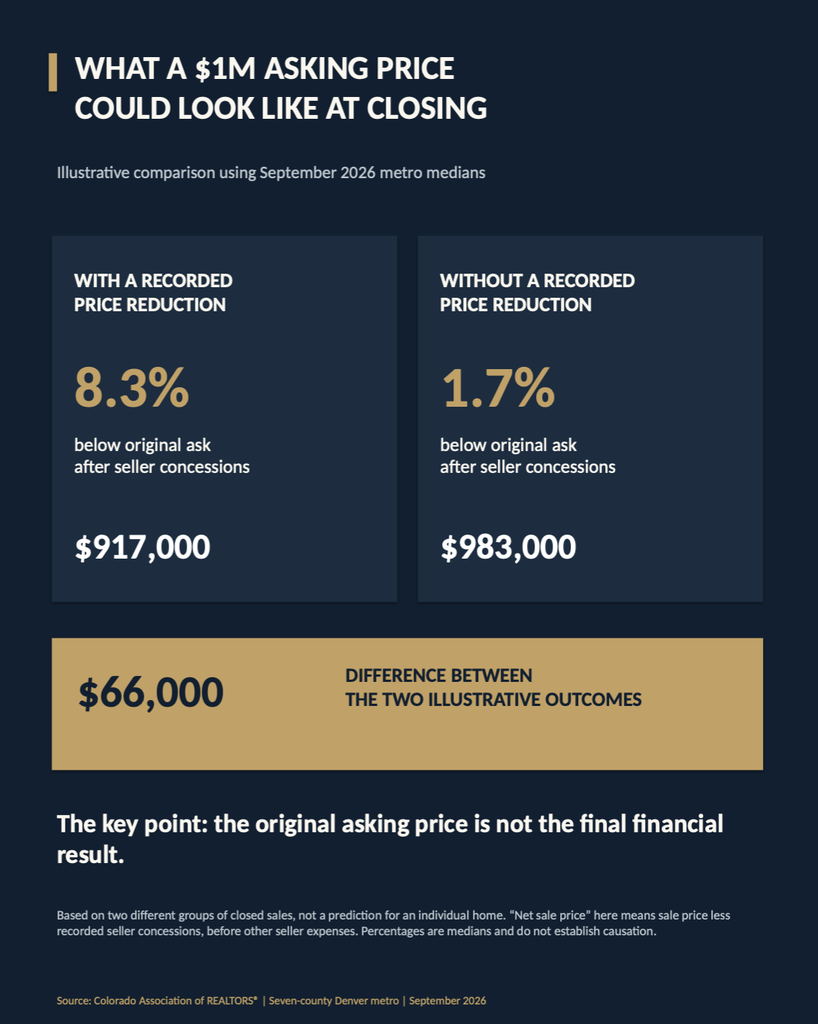
Difference between the two illustrative outcomes: $66,000.
That’s a significant contrast.
But here’s an important distinction: This is not the average cost of a price reduction.
These percentages describe two different groups of completed transactions. They do not establish that reducing a price caused the difference, nor do they predict what any particular property will sell for.
And “net sale price after concessions” is not the seller’s final take-home amount after commissions, mortgage payoff, and other selling expenses.
Still, the finding deserves attention.
A higher asking price doesn’t guarantee a higher selling price. And seller concessions can affect the financial outcome even when the contract price looks strong.
That’s why I evaluate the likely net result not simply the number displayed on the listing.
Are Buyers Now in Control?
Not universally.
Real estate is hyperlocal. Negotiating power can change dramatically by neighborhood, price range, property type and condition.
A thoughtfully priced, well-presented home in a desirable location may still attract strong interest and favorable terms.
Another property even in the same zip code, may face limited showings and repeated objections about price or condition.
That’s why I wouldn’t declare the entire Denver metro a buyer’s market based on one statistic.
But the broader direction is becoming clearer.
Buyer activity has weakened. Negotiations are common. And sellers can no longer assume that the competitive conditions of 2021 or 2022 will carry their listing.
The advantage is shifting – not equally everywhere, but meaningfully enough that buyers and sellers need to adjust their expectations.
What This Means for Sellers
The goal isn’t to panic, slash your asking price or automatically offer concessions.
It is to enter the market with a strategy grounded in current conditions.
Before recommending a listing price, I evaluate how your home compares with active competition, which properties buyers are choosing, recent comparable sales, current buyer activity, property condition, and concessions appearing in completed transactions.
I also evaluate which improvements could meaningfully change buyer perception—and which are unlikely to justify their cost.
Then I model realistic outcomes:
• An offer at asking price with seller concessions.
• A lower offer without concessions.
• A longer marketing period with additional carrying costs.
Each scenario affects your bottom line differently.
Because the strongest offer isn’t necessarily the highest.
It’s the offer that best protects your financial outcome while managing the risk of getting to closing.
The objective isn’t simply to put your home on the market.
It’s to position it to compete.
What This Means for Buyers
This market may offer opportunities that were difficult to find when buyers faced intense competition.
Depending on the property, buyers may have more room to negotiate on price, closing costs, financing assistance, inspection issues, or timing.
But leverage isn’t a blank check.
A home that’s been listed for 60 days isn’t automatically overpriced. And a seller offering a credit isn’t necessarily desperate.
The opportunity is to identify which properties have genuine negotiating flexibility, understand what comparable sales support, and evaluate how different contract terms affect your total cost of ownership.
Sometimes a seller-paid financing incentive may be more valuable to a buyer than a modest price reduction. In other situations, negotiating the purchase price may be the better long-term decision.
The best negotiation isn’t always the biggest price cut. It’s the arrangement that creates the most value for your situation.
And terms matter.
What’s Next for Denver’s Housing Market?
The September numbers suggest a market in transition.
If buyer demand remains subdued, I expect negotiation to continue playing a significant role in the near-term market.
That doesn’t mean widespread price declines are inevitable.
It means buyers are likely to remain selective, and sellers will need to compete more carefully for their attention.
The indicators worth watching include pending sales, inventory relative to buyer demand, mortgage financing conditions, marketing times, and the frequency of seller concessions.
A meaningful rebound in buyer activity could shift the balance again.
Until then, neither buyers nor sellers should base their decisions on assumptions from a different market cycle.
Today’s market requires today’s strategy.
Frequently Asked Questions About the Denver Housing Market
1. Is Denver experiencing a buyer’s market in 2026?
Buyers are gaining negotiating power, but that doesn’t mean every Denver-area neighborhood is a buyer’s market.
September 2026 data shows weaker sales activity and a high percentage of transactions involving price reductions or seller concessions.
However, conditions vary by neighborhood, property type, price range, and inventory.
A home in Lone Tree may face a very different competitive environment than a similar-priced property in Parker, Highlands Ranch, or Cherry Creek.
A neighborhood-level market analysis is essential before deciding how much leverage buyers or sellers actually have.
2. Do I have to reduce my Denver home’s asking price to sell in 2026?
No. A price reduction isn’t automatically necessary.
The right decision depends on your property’s initial asking price, condition, competing listings, showing activity, and buyer feedback.
If your home isn’t attracting qualified showings, the advertised price may need attention.
If showings are strong but offers aren’t materializing, buyers may be raising concerns about value, condition, or other terms.
September’s data shows how frequently reductions occurred, but it doesn’t identify why each seller made that decision.
Price adjustments should be strategic not a reaction to what everyone else appears to be doing.
3. Should I reduce my asking price or offer a seller concession?
A price reduction may be more effective when a home isn’t attracting showings. A seller concession may be useful when buyers are interested but need help with eligible closing costs or financing expenses.
The decision should be guided by buyer behavior.
Are buyers viewing the listing online but not scheduling showings? Are they touring the property but not submitting offers? Are offers coming in with requests for closing-cost assistance?
Each situation points to a different potential obstacle.
Before choosing a strategy, evaluate showing activity, buyer feedback, competing properties, financing restrictions, and expected net proceeds.
4. How can I price my home correctly without leaving money on the table?
Start with current market evidence not yesterday’s peak prices or an aspirational number.
A sound pricing strategy evaluates recent comparable sales, competing active listings, pending activity, property condition, and the likely buyer pool.
Then consider how your home compares with the alternatives buyers will see at the same price.
The objective isn’t automatically to list low or high.
It’s to establish the strongest defensible market position for your specific property, attract qualified buyers, and negotiate from a position of strength.
5. Is now a good time to buy a home in Parker, Lone Tree or Highlands Ranch?
It can be, depending on your financial readiness, time horizon, and the specific property.
I believe homeownership can be a powerful way to build long-term stability and wealth. But the right time to buy is personal.
Greater negotiating flexibility may create opportunities for buyers who are financially prepared and plan to own for the longer term.
Still, mortgage costs, property condition, local inventory, future maintenance, and long-term value all deserve careful consideration.
Work with a knowledgeable local real estate advisor and lender to understand your options before making a decision.
A neighborhood-level analysis is far more useful than assuming every seller is willing to negotiate.
The Market Hasn’t Stopped Moving. The Negotiating Power Has.
Denver’s housing market isn’t collapsing.
It’s recalibrating.
Buyers are more selective. Sellers are negotiating. And the gap between what a home is listed for and what it ultimately sells for deserves closer attention.
For sellers, the question isn’t simply, “What can I list my home for?”
It’s “What will today’s buyers realistically pay, and what will I walk away with?”
For buyers, the question isn’t simply, “How much can I get the seller to reduce?”
It’s “Where do I have genuine negotiating leverage, and how do I use it wisely?”
Before You Make Your Next Move, Know Where You Stand.
Whether you’re considering selling your home or looking to take advantage of today’s shifting market, I would welcome the conversation. Reach out to me, Lubna Forbord, Strategic Real Estate Advisor with The Denver 100, at 303-810-1740 or through lubnaforbord.com.
I bring disciplined, data-driven approach to every transaction. My priority is to help you understand your options, negotiate from a position of strength, and protect what you’ve worked hard to build.
The market has changed. Your strategy should reflect it.
Data Source: Colorado Association of REALTORS®, September 2026 seven-county Denver metro market commentary, published October 13, 2026.
The differences in marketing time and net sale price are observational and do not establish causation. Example listed is for illustration purposes only and does not guarantee an actual outcome.